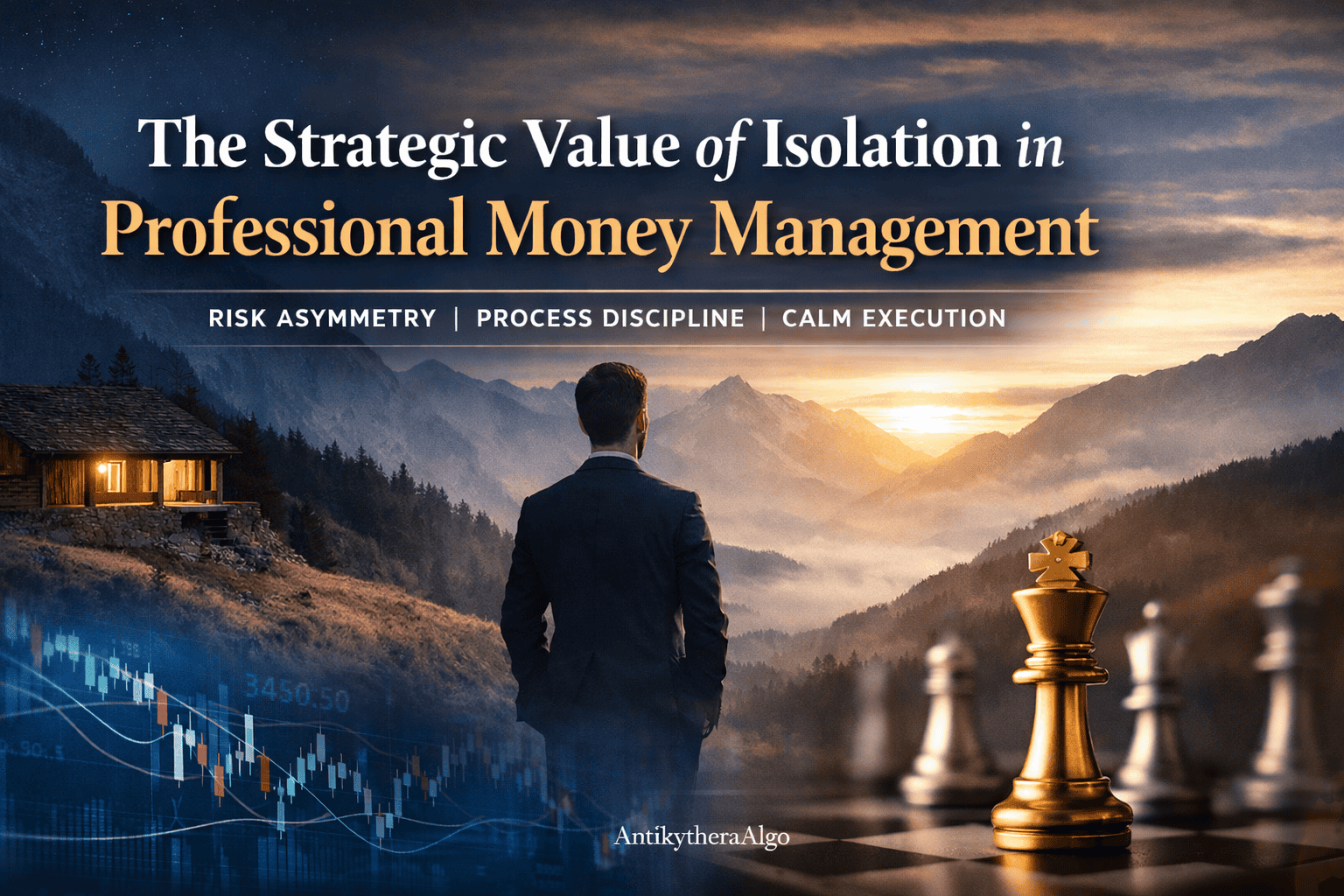
Financial markets are often described as information-driven. In practice, they are behavior-driven systems where outcomes depend less on access to data and more on how consistently decisions are executed under uncertainty.
Across decades of performance data, a recurring pattern emerges: many of the highest-performing fund managers intentionally structure their lives around low noise, limited stimulation, and psychological stability. This behavior aligns closely with measurable drivers of long-term alpha.
1. Information Volume vs. Decision Quality
Empirical studies in behavioral finance show that beyond a certain threshold, additional information reduces decision accuracy. Cognitive load theory suggests that excessive inputs increase error rates, especially in probabilistic environments.
In markets:
- Signal-to-noise ratios decline as information frequency rises
- Overexposure to news increases trade frequency without improving expectancy
- Higher turnover correlates with lower net returns after costs
Isolation effectively caps information intake, preserving decision efficiency per unit of data consumed. Fund managers operating in low-noise environments tend to trade less, but with higher conviction and better payoff asymmetry.
2. Volatility Exposure Is Psychological, Not Just Financial
Market volatility does not impact portfolios directly—it impacts decision-makers first.
Quantitatively:
- Drawdowns amplify loss aversion by ~2–2.5x (per prospect theory)
- Stress increases reaction speed but reduces accuracy
- Emotional interference raises the probability of process deviation during adverse regimes
Managers who maintain calm routines reduce variance in behavioral responses. Lower behavioral volatility translates into lower strategy slippage, a key determinant of long-term performance.
3. Non-Consensus Positions and Tracking Error Tolerance
Alpha generation requires tolerance for tracking error. By definition, outperforming managers must diverge from benchmarks and peer positioning.
Data shows:
- Strategies with higher active share exhibit greater dispersion of outcomes
- Psychological discomfort rises as tracking error increases
- Social and media exposure increases the likelihood of premature exit
Isolation increases the time-weighted probability that a manager remains in a valid position long enough for the payoff to materialize. Solitude functions as a stabilizer for non-consensus risk.
4. Lifestyle Volatility and Strategy Degradation
Performance decay is often gradual and behavioral rather than structural.
High-stress lifestyles statistically increase:
- Decision fatigue
- Overtrading frequency
- Correlation between recent P&L and position sizing
Managers who structure stable routines reduce intra-cycle variance in decision quality. Over multi-year horizons, this stability has compounding effects similar to volatility reduction in portfolios.
5. Diminishing Returns to Visibility
Early in a career, visibility may correlate with opportunity. Beyond a certain capital base, it introduces negative externalities:
- Narrative pressure
- Reputation risk influencing position management
- Reduced willingness to be wrong publicly
Quantitatively, visibility increases career risk sensitivity, which often leads to benchmark hugging and reduced asymmetry. Isolation decouples performance decisions from reputational constraints.
6. Calm as a Structural Alpha Multiplier
In efficient markets, gross alpha is limited. Net alpha depends on:
- Cost control
- Error minimization
- Avoidance of catastrophic loss
Calm does not increase hit rate—but it reduces fat-tail errors. Over long horizons, avoiding a small number of large mistakes contributes more to performance than marginal improvements in prediction accuracy.
Conclusion: Calm Optimizes the Distribution, Not the Mean
The preference for isolation among top fund managers is not aesthetic. It is statistical.
Isolation:
- Reduces behavioral variance
- Increases adherence to process
- Improves survival through adverse regimes
Markets do not reward constant activity. They reward consistency under uncertainty.
In quantitative terms, calm does not maximize short-term returns. It maximizes the probability of staying in the game long enough for asymmetry to compound.
Somesh Nandy


