
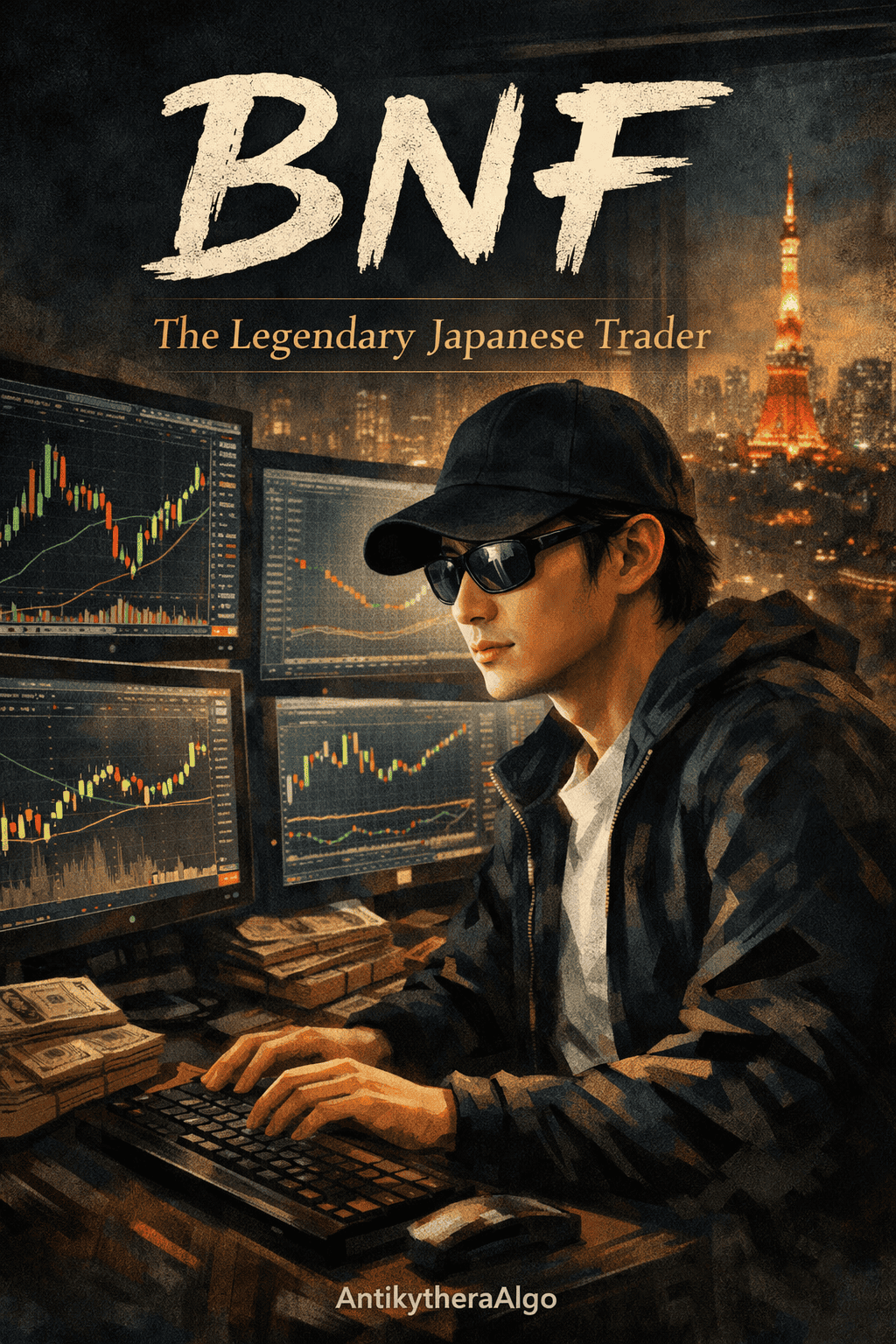
Markets often celebrate loud personalities—bold predictions, aggressive leverage, dramatic wins. Yet one of the most extraordinary trading journeys ever recorded belongs to a man who avoided noise almost entirely.
Known simply as BNF, the Japanese trader’s story is not one of spectacle, but of precision, patience, and deep respect for market structure. His journey from a modest beginning to mastery of the money market remains a masterclass in analytical thinking and emotional discipline.
This is not folklore. It is a study in how markets reward process over prediction.
Phase I: A Quiet Entry Into Chaos
BNF entered the market in the late 1990s, an era defined by Japan’s post-bubble stagnation and the global rise of retail electronic trading. With limited capital and no institutional backing, he did what most traders do at the start—he observed.
Rather than chasing narratives or macro opinions, BNF focused on price behavior itself. His early trades were small, deliberate, and unemotional. Losses were treated as data, not personal failure.
Where many beginners searched for a single winning formula, BNF searched for repeatability.
The market, for him, was not an enemy—it was an information system.
Phase II: From Indicators to Structure
As experience accumulated, BNF moved away from indicator-heavy strategies. He discovered that lagging tools explained the past far better than they guided the future.
Instead, his attention narrowed to:
- Order flow and liquidity concentration
- Intraday price memory
- How price behaved around obvious levels
This was a critical transition. BNF stopped asking whether a stock was cheap or expensive and focused instead on whether participants were forced to act.
In this phase, he internalized a core money market principle:
Price moves not because of opinion, but because of imbalance.
Phase III: Capital Compounding Through Restraint
BNF’s rise was not explosive—it was consistent.
He sized positions conservatively relative to liquidity, avoided illiquid names, and refused to scale recklessly after wins. His edge did not come from leverage, but from capital efficiency.
Losses were frequent but small. Profits were allowed to compound.
This discipline aligned him naturally with money market thinking:
- Protect capital first
- Exploit high-probability asymmetry
- Avoid situations where uncertainty cannot be priced
While others attempted to forecast economic recovery or corporate turnarounds, BNF focused on what the tape was revealing in real time.
Phase IV: Emotional Neutrality as an Edge
One of BNF’s most underappreciated advantages was emotional neutrality.
He did not seek validation from the market. A winning trade carried no celebration; a losing trade carried no frustration. This neutrality allowed him to operate in volatile conditions where emotional traders systematically self-destructed.
In practical terms, this meant:
- No revenge trading
- No overtrading after success
- No attachment to market direction
BNF understood that emotions distort risk perception. By eliminating emotional interference, he allowed probability—not impulse—to guide decisions.
Phase V: Integration Into the Money Market Mindset
At maturity, BNF’s trading style resembled that of professional money market operators rather than speculative retail traders.
His focus shifted toward:
- Liquidity preservation
- Transaction cost efficiency
- Consistency across market regimes
He treated markets as ecosystems, not battlefields. When conditions were unfavorable, he reduced activity. When structure aligned, he executed decisively.
This adaptability allowed him to thrive while many contemporaries disappeared.
What BNF’s Journey Teaches Modern Traders
BNF’s story carries enduring lessons:
- Silence is often an advantage
- The best traders react less, not more
- Capital survives before it compounds
- Markets reward observation, not conviction
His success was not built on secret indicators or privileged information, but on clarity of thought and relentless respect for risk.
Closing Reflection
BNF did not attempt to dominate the market.
He listened to it.
By aligning his behavior with liquidity, structure, and probability, he transformed modest capital into extraordinary results—quietly, methodically, and sustainably.
In an era obsessed with speed and noise, BNF’s journey remains a reminder that the deepest edge in the money market is not aggression—but understanding.
Somesh Nandy.


